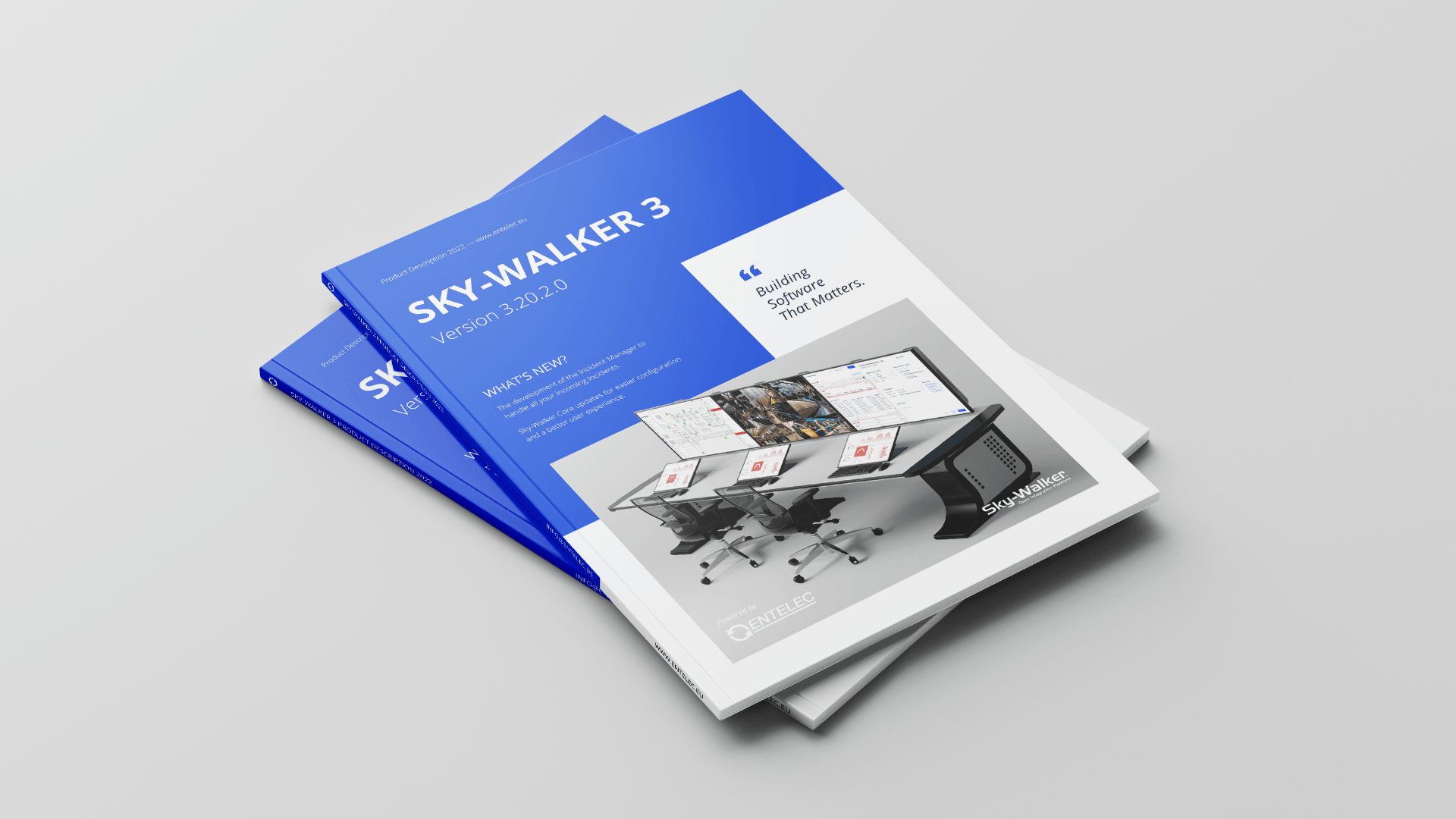
Download Product Ebook
 View all our solutions
 Sky-Walker Architecture
 View all our integrations
 Book Protocol workshop
 Our Company
 Contact Us
 View All Our Case Studies
 Become a PSIM Partner
 Become a Sky-Walker PSIM partner today!
 English
 Français
 Nederlands
Open Integration Platform for Security, Safety & Building Systems
Sky-Walker's modular integration platform unifies diverse security, safety, and building management systems into a single, intelligent control environment. Manage access control, CCTV, fire detection, HVAC, lighting, and hundreds of other systems from one central interface.
What is System Integration?
System integration is the process of combining separate subsystems—security systems, safety systems, building management systems—into one unified, intelligent platform. Rather than operating isolated applications, Sky-Walker brings everything together under centralized monitoring, control, and management.
Core Integration Objectives
- Centralized Monitoring: A single dashboard displays the status from all connected systems.
- Unified Control: Issue commands to any system from one interface.
- Intelligent Coordination: Systems communicate with each other, enabling automated, coordinated responses.
- Simplified Operations: Operators master one platform instead of learning multiple system-specific applications.
- Cross-System Automation: Create workflows where events in one system trigger actions in others.
- Enhanced Situational Awareness: Comprehensive view of security, safety, and operational status in real time.
Why System Integration Matters
Unified Control & Monitoring
Operate all systems from a single dashboard. No more switching between applications manage security, safety, and building operations simultaneously.
Reduced Operator Complexity
Your team learns one interface,
not dozens. Simplified operations reduce training time, minimize errors, and improve
response times.
Cross-System Intelligence
Enable systems to share data and trigger automated workflows. Security alerts can trigger building controls, fire systems can override access restrictions.
Lower Total Cost of Ownership
Consolidate hardware,
reduce software licenses, minimize integration labor,
and decrease ongoing
support costs.
Security systems
Integrate all security subsystems for comprehensive physical security management. From access control to intrusion detection, manage your entire security posture on a single platform.
- Access Control: Manage badges, credentials, door locks, entry points, and access permissions across your facility.
- CCTV & Video Management: Integrate video cameras, DVRs, NVRs, and video analytics into centralized monitoring.
- Intrusion & Burglary Detection: Connect motion sensors, door/window sensors, and intrusion alarms for proactive threat detection.
- Intercom Systems: Integrate voice communication systems for two-way facility-wide communication.
- Alarm Management: Centralize alarm events, escalation procedures, and operator response workflows.
- Security Analytics: Leverage integrated data for threat analysis, pattern recognition, and investigative intelligence.
Safety systems
Integrate critical safety systems to protect lives and assets. Fire detection, emergency response, and public address systems work together to ensure rapid, coordinated emergency response.
- Fire Detection & Alarms: Connect fire sensors, smoke detectors, and manual pull stations for unified fire response.
- Fire Protection Systems: Integrate sprinkler systems, suppression controls, and emergency shut-off valves.
- Public Address Systems: Activate facility-wide announcements during emergencies or facility-wide communications.
- Emergency Lighting: Coordinate emergency lighting activation during fire or security events.
- Gas Detection: Monitor hazardous gas levels and trigger evacuation/ventilation protocols.
- Emergency Response: Automate response workflows lock doors, activate alarms, illuminate exits, notify authorities.
Building systems
Optimize facility operations by integrating HVAC, lighting, energy management, and environmental controls. Coordinate building systems with security and safety for holistic facility management.
- HVAC Systems: Monitor and control heating, ventilation, and air conditioning across multiple zones.
- Lighting Control: Manage illumination levels, occupancy-based lighting, emergency lighting integration.
- Energy Management: Track power consumption, optimize energy usage, identify efficiency opportunities.
- Environmental Monitoring: Monitor temperature, humidity, air quality, and environmental conditions.
- Power Management: Control backup generators, UPS systems, and power distribution.
- Elevator/Transportation: Monitor elevator status, control access, coordinate with security systems.
How do we integrate systems?
Modular integration
The system can run on a single PC, or can be connected to a network by following the client/server model.
Communications
The communication between the different subsystems and the integration platform is done through Ethernet, using the TCP/IP protocol.
Configurations
The configuration depends on the amount of server resources needed in order to connect the different subsystems. Some of the possible configurations are a stand-alone configuration, a client-server configuration with one server or a client-server configuration with multiple servers.
Subsystems
All intelligent subsystems work autonomously and are connected to the Ethernet either directly or via a converter to enable communication with the Integration software.
Deployment Models for Every Organization
Sky-Walker adapts to your infrastructure requirements and scalability needs.
Stand-Alone Deployment: Single PC running Sky-Walker with direct connections to subsystems. Ideal for small facilities with 5-20 integrated devices. No network infrastructure required.
Single Server Client-Server: Central server with multiple operator client workstations. Server manages all integrations and data; clients provide user interfaces for staff. Supports facilities up to 100+ connected systems.
Multi-Server Enterprise Deployment: Distributed servers across multiple locations with load balancing, redundancy, and failover. Multiple operator client stations. Scales to thousands of systems. Ideal for large enterprises, campuses, and city-wide deployments.
Hybrid Cloud Architecture: On-premise servers with cloud-hosted components. Supports remote monitoring, mobile access, and data analytics while maintaining local security and control.
System Integration Process
Integrating systems requires careful planning, skilled engineering, and thorough testing.
Discovery & Assessment: Document all systems to be integrated: protocols, hardware, software versions, communication methods, and current operator workflows.
Architecture Design: Design Sky-Walker deployment—server configuration, network topology, redundancy, and failover strategies.
Driver Development: Develop or configure communication drivers for each system. If proprietary systems lack drivers, our team develops custom ones.
Integration Configuration: Configure Sky-Walker to map data from each system, create workflows, design user interfaces, and establish automated responses.
Testing & Validation: Comprehensive testing: individual system connections, cross-system communication, workflow automation, failover scenarios, and load testing.
Staff Training: Train operators on the integrated system, normal operation procedures, and emergency response.
Go-Live & Monitoring: Transition to production, monitor performance, address issues immediately, and optimize workflows based on operational feedback.
Business Benefits of System Integration
- Faster Incident Response: Unified view enables operators to respond to threats and emergencies in seconds, not minutes.
- Improved Operator Efficiency: Single interface vs. multiple applications reduces operator cognitive load and training requirements.
- Better Decision Making: Comprehensive situational awareness enables smarter, faster decisions.
- Automated Workflows: Eliminate manual processes—systems coordinate automatically (e.g., fire alarm triggers door unlock, PA activation).
- Reduced Costs: Consolidate hardware, licenses, and support. Fewer staff to manage multiple systems.
- Regulatory Compliance: Integrated logging, audit trails, and reporting simplify compliance with industry and legal requirements.
- Future-Proof Investment: Modular architecture means you can add new systems and technologies without replacing the entire platform.
- Enhanced Security: Comprehensive monitoring reveals security patterns, anomalies, and potential threats.
- Operational Intelligence: Integrated data enables analytics, trend analysis, and predictive insights.
Common Integration Challenges & How We Solve Them
Legacy Systems with Proprietary Protocols: Our team develops custom drivers and translation layers. We've successfully integrated systems dating back 20+ years.
Network Isolation & Firewalls: We design integration architectures that respect security policies. Systems can communicate through secure gateways and firewalls.
Data Inconsistency Between Systems: Sky-Walker's integration layer normalizes data from disparate sources, ensuring consistent, reliable information across the platform.
Performance Under Load: Our architecture supports thousands of simultaneous system connections. We design for scale from initial deployment.
Operator Training on New Platform: Comprehensive training programs, intuitive interfaces, and phased rollout strategies ensure smooth operator adoption.
System Downtime During Integration: We design integration to minimize operational disruption. Existing systems operate normally while integration occurs in parallel.
Our Integration Expertise
Our integration team brings decades of combined experience in security systems, building automation, PSIM platforms, and system architecture:
- Security Systems Engineers: Deep expertise in access control, CCTV, intrusion detection, and alarm systems.
- Building Automation Specialists: HVAC, lighting, energy management, and environmental control expertise.
- Network Architects: Design scalable, secure, reliable integration architectures.
- Software Engineers: Custom driver development, API integration, and workflow automation.
- Project Managers: Ensure projects stay on schedule, within budget, and meet technical requirements.
- Training Specialists: Prepare your team for platform adoption and operational excellence.
Related Resources
Frequently Asked Questions
How many systems can Sky-Walker integrate?
Sky-Walker has integrated 500+ different systems across security, safety, and building management. If a system uses standard protocols (BACnet, Modbus, etc.) or vendor APIs, we can integrate it. Even proprietary systems can be integrated through custom driver development.
What if my system isn't on your supported list?
Contact our integration team. If the system uses standard communication protocols, integration is straightforward. If proprietary, our R&D team can develop a custom driver.
Does integration require me to replace existing systems?
No. Sky-Walker is built to work with existing systems. You can keep your current hardware and software we add integration capabilities without replacement.
How long does system integration take?
Timeline depends on complexity. Simple 5-system integration: 2-4 weeks. Complex enterprise-wide integration: 3-6 months. Our team provides a detailed project timeline after assessment.
Can I add systems later?
Yes. Sky-Walker's modular design enables adding new systems anytime. We can integrate new systems without impacting existing ones.
How is data transmitted between systems?
All communication occurs over standard Ethernet using TCP/IP protocol. Subsystems connect directly to the network or via protocol converters. No special networking hardware required.
What about security and data protection?
Sky-Walker includes robust security controls: user authentication, role-based access control, encrypted communication, comprehensive audit logging, and compliance support for industry regulations.
Can Sky-Walker operate if the network goes down?
Individual subsystems continue operating autonomously. Sky-Walker's functionality is reduced until network connectivity is restored, but critical safety systems (fire, emergency lighting) operate independently.
What kind of support do you provide post-integration?
We offer support options, proactive monitoring, preventive maintenance programs, staff training, and continuous optimization. See our Services page for details.
Ready to Unify Your Systems?
Let's assess your current systems and design an integration solution that maximizes efficiency, improves security, and reduces costs. Our integration specialists are ready to discuss your specific requirements.