


 Download Product Ebook
 View all our solutions
 Sky-Walker Architecture
 View all our integrations
 Book Protocol workshop
 Our Company
 Contact Us
 View All Our Case Studies
 Become a PSIM Partner
 Become a Sky-Walker PSIM partner today!
 English
 Français
 Nederlands
Communication Protocols for Security & Building System Integration
Protocol in communication is necessary to connect your security, safety, and building management systems directly to our Sky-Walker open-integration platform. It is essential that the information coming from your systems is compatible with Sky-Walker, protocol rules are therefore essential.
Building System Integration via Open & Proprietary Protocols
Protocol standards enable your security, safety, and building management systems to connect seamlessly with the Sky-Walker open-integration platform. With support for 500+ integrated systems and both open and proprietary communication protocols, we ensure compatibility across diverse technology environments.
What is a PSIM Communication Protocol?
Just as humans communicate using a shared language, software systems require a specific language to exchange information. A communication protocol is a set of rules that allows one software system to understand and communicate with another.
Through communication protocols, systems can achieve two-way communication—both transmitting and receiving information—or one-way communication where information flows in a single direction. This standardized language is essential for enabling interoperability across different manufacturers' systems.
Why Protocols Matter for System Integration
In modern building and security environments, organizations typically deploy solutions from multiple vendors. Communication protocols act as the bridge that connects these disparate systems, enabling:
Interoperability
Systems from different manufacturers can communicate seamlessly
Building Automation
HVAC, lighting, access control, and fire safety systems operate in unified coordination
Security System Integration
Intrusion detection, video surveillance, and alarm systems share critical data
Centralized
Monitoring
A single interface (like Sky-Walker) can manage all connected systems
Real-time Data Flow
Information flows instantly from sensors and devices to your management platform
Common Protocols Used in Building and Security Systems
Different protocols serve different purposes in building automation and security. Here are the most widely deployed communication standards:
Open protocol
communication
Modbus
BACnet
OpenTouch
OPC
HTTP
FTP
SIA
Proprietary protocol communication
Notifier
FlexC
API
SDK
BACnet
Type: Open Standard
Primary Use: HVAC, lighting, and building management
Key Features: BACnet is an open standard developed specifically for building automation.
It enables interoperability across heating, ventilation, and air conditioning (HVAC) systems, lighting controls, and access control systems from different manufacturers. Widely adopted in commercial and enterprise buildings for centralized climate and energy management.
Modbus
Type: Open Standard
Primary Use: Industrial and building systems integration
Key Features: Modbus is a simple, robust industrial communication protocol available in two variants: Modbus TCP (over Ethernet networks) and Modbus RTU (serial communication). Commonly used for connecting sensors, programmable logic controllers (PLCs), and building management devices. Known for reliability in environments with older industrial equipment.
OPC
Type: Open Standard
Primary Use: Industrial data exchange and SCADA integration
Key Features: OPC enables seamless data sharing between software applications in industrial control systems. OPC Unified Architecture (OPC UA) is the modern standard, supporting cross-platform compatibility and enhanced security. Essential for complex SCADA and data collection environments.
HTTP / API
Type: Open Standard
Primary Use: Web and software system communication
Key Features: HTTP and RESTful APIs enable communication between web applications and cloud-based systems. Increasingly popular for IoT devices, mobile applications, and cloud-connected building systems. Provides flexibility for custom integrations and third-party software connectivity.
FTP (File Transfer Protocol)
Type: Open Standard
Primary Use: File transfer and data synchronization
Key Features: Enables bulk data transfer between systems. Used for backing up system configurations, transferring logs, and synchronizing databases across distributed systems.
SIA (Security Industry Association)
Type: Industry Standard
Primary Use: Security alarm system communication
Key Features: SIA is the standard protocol for intrusion detection and alarm system communication. Widely used for transmitting alarm events, system status, and alerts across security networks. Essential for integration with central monitoring stations and security operations centers.
Open vs Proprietary Protocols: Understanding the Difference
Open Protocols (Standards)
Open protocols are publicly documented specifications available to any software manufacturer. They enable true interoperability—systems from different vendors can communicate using the same protocol without licensing fees or vendor lock-in. Examples include BACnet, Modbus, OPC, HTTP, and SIA. Open protocols promote innovation, reduce costs, and provide flexibility in vendor selection.
Proprietary Protocols (Vendor-Specific)
Proprietary protocols are developed and owned by individual manufacturers. Examples include Notifier (fire detection), FlexC, API and SDK implementations by specific vendors. While proprietary protocols may offer optimized performance for specific devices, they require manufacturer support for integration and can lock organizations into single-vendor ecosystems.
System Architecture: How Protocols Connect Everything

Supported Protocols and Systems
Sky-Walker integrates with a comprehensive range of communication protocols and systems. Here's a quick reference guide:
| Protocol | Type | Typical Use Case |
|---|---|---|
| BACnet | Building Automation | HVAC, Lighting, Access Control |
| Modbus TCP/RTU | Industrial/BMS | Sensors, Controllers, PLC devices |
| OPC / OPC UA | Industrial Data Exchange | SCADA Integration, Data Collection |
| HTTP / REST API | Web Integration | Software Communication, IoT, Cloud |
| SIA Protocol | Security Alarms | Intrusion Systems, Event Monitoring |
| FTP | File Transfer | Data Sync, Backups, Log Transfer |
| Notifier | Fire Detection | Fire Alarm Systems |
| FlexC / Custom APIs | Vendor-Specific | Manufacturer-Optimized Integration |
Understanding the Difference: API vs Protocol
While often confused, APIs (Application Programming Interfaces) and communication protocols serve different purposes:
- Communication Protocols are the low-level rules for how devices exchange data (e.g., how electrical signals are sent, how data packets are structured). Examples: Modbus, BACnet, TCP/IP.
- APIs are high-level interfaces that define how software applications request services from each other. APIs often use protocols (like HTTP) as their transport layer but provide a more abstracted, user-friendly way to interact with systems.
In practice, modern systems frequently use HTTP/REST APIs that operate on top of TCP/IP protocols, creating multiple layers of communication abstraction.
How Sky-Walker Integrates Communication Protocols
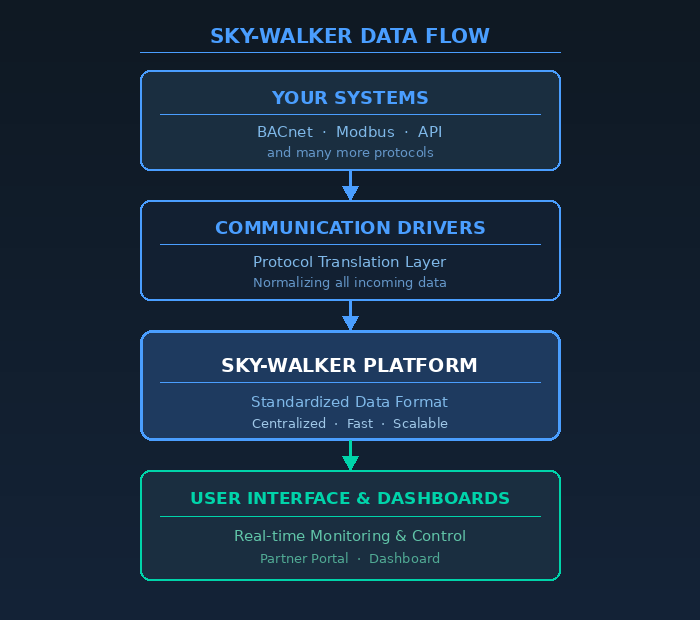
Integration of diverse communication protocols requires specialized translation and adaptation layers. Here's how Sky-Walker handles this complexity:
Communication Drivers as Protocol Translators
Each connected system communicates using its native protocol. Sky-Walker uses specialized communication drivers that act as translators, converting protocol-specific data into a standardized format the platform can understand and manage. The driver:
- Recognizes incoming data in the system's native protocol
- Translates it into Sky-Walker's standard data format
- Routes the information to the appropriate platform modules
- Makes the data visible and actionable in the user interface
Protocol Rules and Driver Compatibility
The effectiveness of integration depends on two critical factors:
- Protocol Rules: The specific rules and parameters of the system's native communication protocol
- Driver Adaptability: The driver's ability to correctly interpret and translate those protocol rules into Sky-Walker's format
This is why proper protocol configuration and driver selection are essential to successful system integration.
Integration Architecture Workflow
Related Integration Topics
Deepen your understanding of system integration with these complementary resources:
- Learn more about CCTV system integration and how video management systems connect to Sky-Walker
- Explore building management system protocols and HVAC/lighting integration strategies
- Discover the Sky-Walker open integration platform and its architectural advantages
Not sure if your systems can integrate?
We've integrated 500+ systems using various communication protocols. Let our experts assess your environment.
What is a communication protocol?
A communication protocol is a set of rules and standards that enable software systems to exchange information. Just as humans use language to communicate, software systems use protocols to understand and share data with each other.
What protocols are commonly used in building automation?
The most common building automation protocols include BACnet (HVAC and lighting), Modbus (sensors and controllers), and HTTP/APIs (cloud-connected systems). Each serves different parts of the building management ecosystem.
What is the difference between BACnet and Modbus?
BACnet is specifically designed for building automation and offers strong interoperability across HVAC, lighting, and access control systems. Modbus is more general-purpose and widely used in industrial environments for connecting sensors and PLCs. Both are open standards but serve different application domains.
What is an open protocol?
An open protocol is a publicly documented communication standard available to any manufacturer. Open protocols promote vendor independence, reduce costs, and enable true interoperability across different systems.
Can Sky-Walker integrate with proprietary protocols?
Yes. While open protocols provide standardized integration, Sky-Walker can also integrate with proprietary protocols through custom drivers developed for specific manufacturers. Contact our integration team for details.
What is the role of a communication driver?
A communication driver acts as a translator between a system's native protocol and Sky-Walker's standardized format. It recognizes incoming data, translates it, and routes it to the
appropriate platform modules.
Become an expert in communication protocol
Many protocols, both open and proprietary, are used to transmit data and only a few of them, such as Modbus, Backnet or API, are known to the general public. However, there are many more protocols and it is necessary to be aware of them.
Through a personalised workshop, we would like to help you discover the different communication protocols, their advantages and their use.